 EU
EU da
da no
no sv
sv fi
fi

Avoid Damaging Your Non-Stick Pans
Now you can ensure your non-stick pans don’t get so hot that they become damaged. Keep the temperature below 220°C.

Non-Stick is Amazing
Nothing sticks to your pan, and it’s easy to clean. However, many people find that their pans wear out after just a few years. This is almost always because they’ve been overheated.
All non-stick coatings become softer as the temperature increases. At low to medium heat, it’s actually quite difficult to damage the coating.
We’ve tested many types of non-stick coatings, and Ztove pans are coated with the best we could find.
The Maximum Temperature for Your Non-Stick Pan
We conducted a test using a metal spatula pressed down onto a pan. A robotic arm moved the spatula back and forth 1,600 times with 1,350 g of pressure. We repeated this on non-stick pans at 10°C intervals.
Afterward, we analyzed the durability by assessing how much damage the pans sustained.
The Results:
Between 0–200°C, it takes significant effort to damage your pans. For example, we recommend cooking chicken breast at 170°C and fish at around 190°C.
From 200–220°C, you need to be more careful. If you scrape aggressively, you might remove some of the coating. However, with proper care and utensils, your pan should be fine.
Above 220°C, all types of non-stick coatings become exponentially more fragile. At temperatures over 260°C—equivalent to the smoke point of many cooking oils—the coating can start peeling off on its own.
If you’ve ever had a non-stick pan that broke down despite avoiding metal utensils, it’s likely because the pan was exposed to temperatures over 260°C.
Our recommendation is to keep the temperature below 220°C.
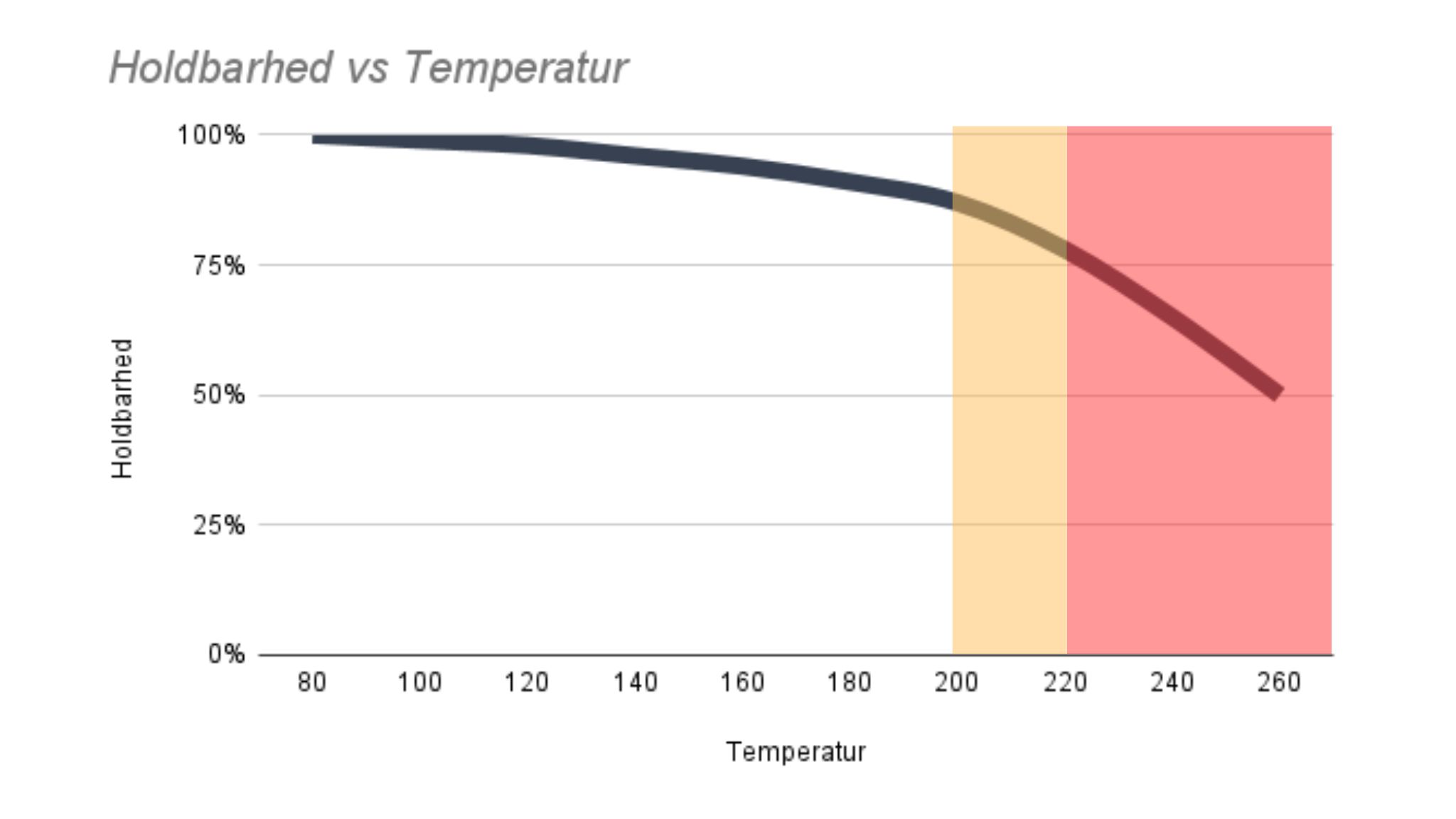
(The curve is an illustration of the results we found.)
Additional Tips
Avoid using metal utensils on Ztove non-stick pans, as they can scratch the non-stick coating. Coarse salt is also highly abrasive and can damage the coating if rubbed against it.
Cooking with fats or oils at higher temperatures can cause a layer to form on top of the coating, which may damage the non-stick surface over time. It is always recommended to clean your pan using the soft side of a sponge or a soft brush, along with a small amount of dish soap, cleaning twice if necessary.
Ensure the pan is placed correctly and centrally on the hob zone, as improper placement can cause uneven heating and damage the coating along the edges.